
 EN
EN
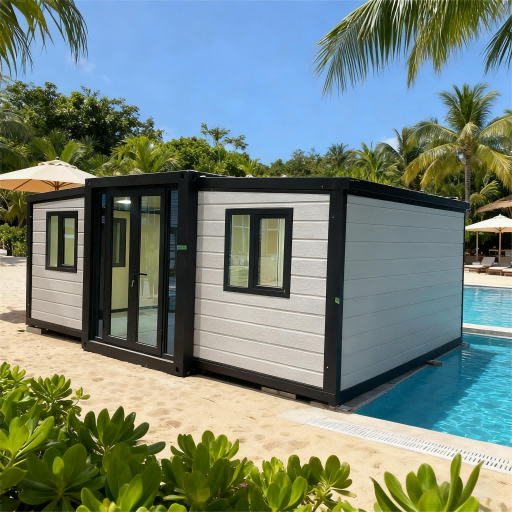
Tiny houses have rapidly become a global living trend, beloved by young professionals, remote workers and those pursuing a minimalist lifestyle. The core appeal of tiny houses lies in their ability to break the stereotype that "small space means poor comfort", and prefabricated tiny houses, with advanced R&D and production technology, have become the mainstream choice for realizing this balance. As a professional manufacturer integrating R&D, production and sales of prefabricated houses, we own more than ten patented technologies including product invention and appearance patents, and all products are manufactured through standard processes with strict quality inspection before delivery. Our expandable house, detachable container house, apple capsules and other core products perfectly interpret how scientific design and modular technology can maximize space utilization while ensuring a high level of living comfort in tiny houses.
Intelligent Spatial Planning: The Foundation of Tiny House Space Optimization
The key to maximizing space in tiny houses is not blind compression, but intelligent spatial planning, which is the cornerstone of all our prefabricated tiny house design. Our professional design team is able to issue customized design plans for customers quickly, and the core of the planning is to realize the integration and separation of functional areas. For example, our apple capsules adopt a one-piece spatial design, which skillfully combines living, sleeping and leisure areas without obvious partition walls, making the limited space look open and transparent. We also pay attention to the streamline of moving lines in the house, eliminating all redundant spatial design, so that every step in the tiny house is smooth, and the actual use efficiency of the space is greatly improved. At the same time, the spatial planning of all our tiny house products is based on human body engineering, ensuring that every functional area meets the daily use habits of people, and avoiding the sense of restraint caused by unreasonable design.
Modular & Expandable Structures: Unlocking Flexible Space Potential
Modular and expandable structural design is the core technical advantage that our prefabricated tiny houses can maximize space, and it is also the core content of many of our patented technologies. Our expandable house is a typical representative of this design concept—only 4 workers are needed to complete the expansion and construction in 20 minutes, and the compact storage state can be quickly converted into a spacious living space, which not only solves the problem of difficult transportation and installation of prefabricated houses, but also realizes the flexible adjustment of space according to actual needs. For the detachable container house, we have realized the high integration of modular design, with 1 container able to load 16 units, and each unit can be freely combined and spliced according to the customer's living needs, forming different spatial layouts such as single room, two bedrooms and one living room. This modular design not only saves the production and construction cost, but also makes the space of tiny houses no longer fixed, and can be adjusted with the change of living population and usage scenarios.
Multifunctional Furnishings & Vertical Space Utilization
Maximizing space in tiny houses also relies on the combination of multifunctional furnishings and in-depth development of vertical space, which is an important part of our product customization service. All our prefabricated tiny house products can be equipped with customized embedded and foldable furniture according to customer needs: foldable tables and chairs can be stored when not in use, wall beds can be put away to release the living space during the day, and embedded storage cabinets make full use of the wall space without occupying the ground area. In addition, we focus on the development of vertical space in products such as apple capsules and space capsules, designing suspended storage racks and layered storage areas, which make the three-dimensional space of the tiny house fully utilized. All furniture and storage designs are integrated with the house structure, maintaining the overall beauty of the tiny house while realizing the maximum use of space.
Thoughtful Details: Ensuring Comfort in Limited Space
Maximizing space does not mean compromising on comfort, and thoughtful humanized details are the key to our prefabricated tiny houses to ensure living comfort. First of all, all our products are produced in accordance with international standards such as CE and ISO9001-2016, and use energy-saving and environmental protection materials with good thermal insulation and sound insulation effects, which effectively isolate the external environment and ensure a quiet and comfortable indoor living environment. Secondly, our products such as apple capsules and expandable house are designed with large-area panoramic windows and scientific ventilation systems, which ensure sufficient natural light and air circulation in the tiny house, avoiding the stuffy and dark problem common in small spaces. In addition, every product must undergo strict quality inspection before leaving the factory, from the firmness of the structure to the smoothness of the furniture, all are strictly checked to ensure the quality of use. Our one-stop service from design, production to installation also ensures that every detail of the tiny house meets the customer's comfort requirements, making the tiny house a warm and comfortable home rather than a simple "small space".
Tiny houses are a reflection of a minimalist and high-quality life concept, and the key to realizing this concept is to balance space utilization and living comfort. Relying on more than ten patented technologies, standard production processes and strict quality inspection systems, our prefabricated tiny house products represented by expandable house, detachable container house and apple capsules, through intelligent spatial planning, flexible modular design and humanized detail creation, have truly realized the maximization of space and the uncompromising of comfort. In the future, we will continue to innovate R&D, and bring more high-quality prefabricated tiny house products to customers around the world, making the tiny house life more diverse and comfortable.