 EN
EN
Ultra-Fast Installation: How Folding House Achieves Occupancy in Under 30 Minutes
The Step-by-Step 30-Minute Setup Process: Precision Engineering and Tool-Free Assembly
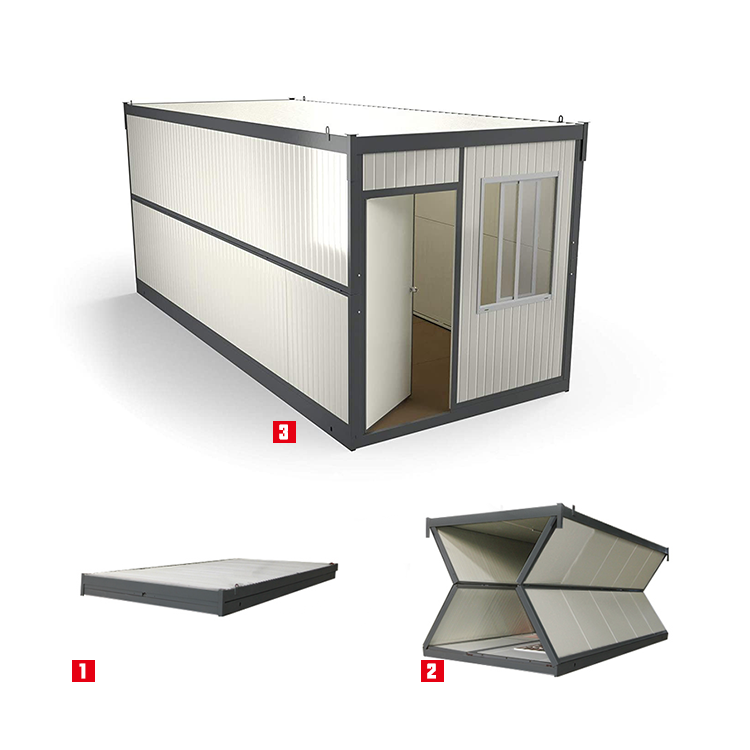
Folding houses achieve rapid deployment through precision-engineered components and fully tool-free assembly. Delivered flat-packed, each unit occupies just 35% of its expanded volume—reducing transport volume by up to 65% versus traditional modular housing. Upon arrival, two to four workers unfold walls and roofs using integrated hinges; no cranes, welding, or manual measurements are required. Locking mechanisms engage automatically to ensure structural stability, followed by quick door/window alignment and utility hookups. This repeatable, error-resistant workflow enables full occupancy in under 30 minutes—making it uniquely suited for time-critical applications like disaster response and remote infrastructure projects.
Certified Speed vs. Structural Integrity: Meeting International Standards Without Compromise
Speed does not come at the expense of safety or durability. Folding houses are engineered to meet or exceed ISO 9001 and ISO 14001 standards for quality and environmental management, with independent verification confirming compliance with international building codes—including wind resistance up to 120 km/h and seismic performance ratings per IBC and Eurocode 8. High-strength steel frames, fire-retardant composite panels, corrosion-resistant coatings, and integrated moisture barriers collectively ensure a minimum 20-year service life—even in extreme climates. This certified balance of acceleration and resilience validates their use across both temporary emergency shelters and permanent residential or commercial installations.
Effortless Storage & Logistics: The Space-Saving Advantage of Folding House Design
Folding house technology redefines efficiency across the entire construction lifecycle—from warehouse storage to last-mile delivery—by transforming volumetric logistics into a strategic advantage.
Flat-Pack Efficiency: Reducing Transport Volume by Up to 65% for Lower Costs and Wider Reach
By collapsing to 35% of their operational footprint, folding houses cut shipping volume by up to 65% compared to conventional modular units. This compression delivers measurable operational benefits:
- Freight cost reductions of 40–50% per unit
- Tripled payload capacity—21 units fit on a single flatbed truck versus 6–8 fixed modules
- Access to infrastructure-constrained sites, including mountainous, island, or conflict-affected regions
Eliminating wasted airspace during transit expands geographic reach without increasing budget or logistical complexity.
Warehouse-to-Site Flexibility: Stacking, Shipping, and On-Demand Unfolding Without Specialized Handling
The design integrates seamlessly with existing global supply chains:
- Units stack vertically in warehouses, tripling storage density
- They conform to standard shipping dimensions—avoiding oversize load permits and associated delays
- Deployment requires only two personnel and no specialized tools or heavy machinery
This plug-and-play system maintains full structural integrity while enabling immediate occupancy—critical for humanitarian deployments, military forward operating bases, and rapid workforce housing.
Folding House as a Prefabricated System: Scalable, Site-Adaptive, and Labor-Light Construction
Folding houses represent a paradigm shift in prefabricated construction—merging speed, scalability, and site versatility without sacrificing quality or regulatory compliance. Unlike traditional builds, they require minimal site preparation: no wet-concrete foundations, no extensive grading, and no on-site framing. As a result, on-site labor is reduced by up to 75% compared to conventional methods (Ponemon Institute, 2023). Their modular architecture supports seamless expansion—from single-unit shelters to multi-story complexes—via vertical stacking or horizontal clustering, adapting equally well to urban infill lots, permafrost zones, or steep terrain. Pre-aligned interlocking frames and factory-integrated utilities eliminate field coordination bottlenecks, allowing small crews to complete what would take days using conventional techniques. Standardized components, consistent manufacturing protocols, and rigorous third-party testing ensure uniform performance across deployments—from UN-led refugee settlements to scalable tech-campus housing.
Key Advantages:
- Scalability: Modules can be added, reconfigured, or removed to match evolving spatial, functional, or demographic needs
- Site adaptability: Engineered for installation on uneven ground, soft soils, floodplains, and other challenging substrates without custom foundation systems
- Labor optimization: A three-person crew achieves full setup in under 30 minutes—accelerating project timelines and mitigating skilled-trade shortages
Frequently Asked Questions (FAQ)
What is the main advantage of a folding house compared to traditional modular housing?
Folding houses offer ultra-fast installation and significant space-saving benefits, reducing transportation volume by up to 65%, which leads to lower shipping costs and easier access to challenging locations.
How durable are folding houses compared to standard buildings?
Folding houses are engineered to meet high international quality and safety standards, ensuring a minimum 20-year service life with resistance to wind speeds up to 120 km/h and seismic events.
What are the logistical benefits of folding houses?
Folding houses can be stacked and transported more efficiently, fit more units per flatbed truck, and allow for ease of deployment in remote or infrastructure-limited areas with minimal personnel and no need for specialized equipment.
How adaptable are folding houses to various environments?
Folding houses can be installed on challenging substrates like uneven ground and floodplains without custom foundations. They offer modularity and scalability, making them ideal for both temporary and permanent solutions.